This article is the first in CPJ’s Ink & Impact series featuring young writers from across the country. In today’s political climate, often marked by cynicism and despair, CPJ’s annual Ink & Impact conference helps Christian young people become messengers of hope. In a world dominated by digital distractions, Ink & Impact develops writers who can articulate complex political topics in an approachable, nuanced way to inform the public.
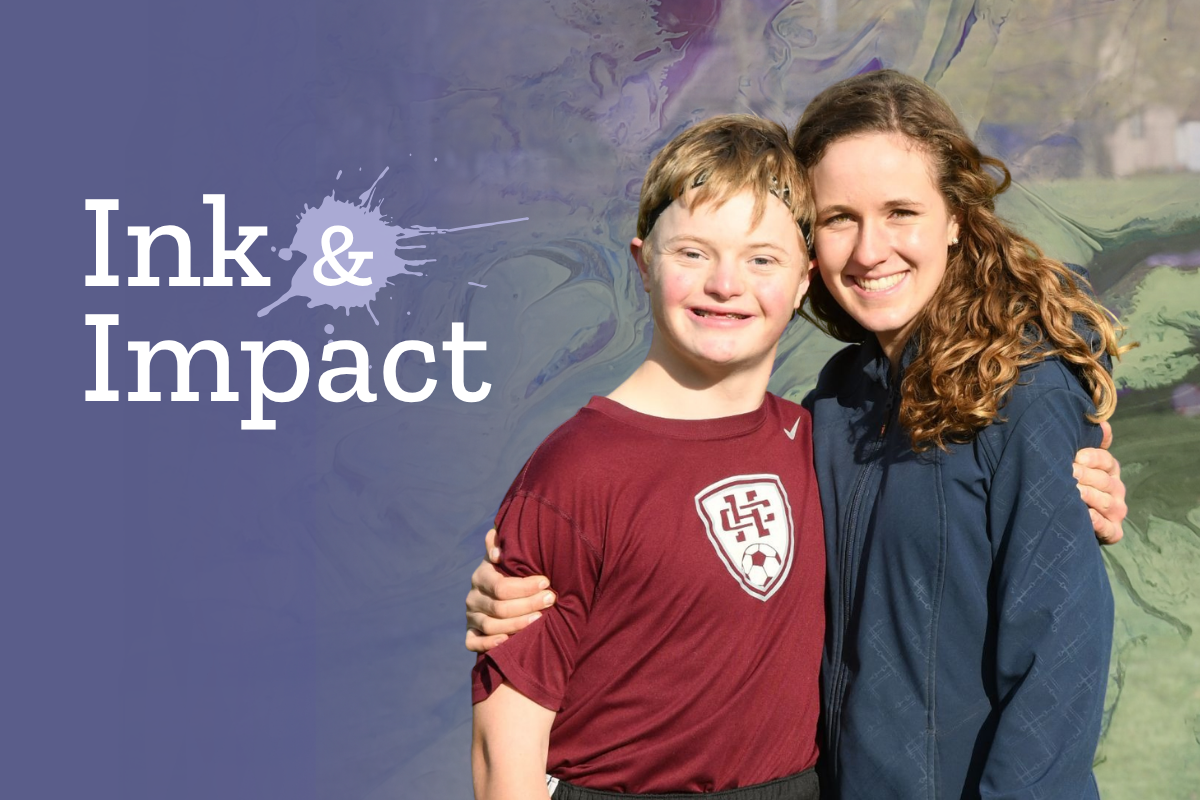
Cheers from onlookers swept upward on the crisp October breeze as we gathered under a brilliant blue sky on the sidelines of the high school soccer field to support a Special Olympics Unified soccer game. Special Olympics Unified Sports exists to bring together students with and without intellectual disabilities to play and compete together with the goal of developing mutual friendships and community. For my younger brother, Joshua, who has Down syndrome, participating in Unified Sports was a dynamic component of his emotional, physical, and social education offered through his school. Unified not only encouraged his development but provided a community that embraced his dignity and celebrated his belonging.
An Era of Uncertainty
Special Olympics is funded in part by grants from the federal government through the Individuals with Disabilities Education Act (IDEA), administered by the Office of Special Education and Rehabilitative Services (OSERS) at the Department of Education (ED). Unified Sports reaches 19.5 million young people in more than 10,800 schools across the country. In March 2025, President Trump signed Executive Order 14242, with the stated goal of ultimately closing ED. Though Congressional action is ultimately required to close ED and reappropriate funds for IDEA, parents and school personnel are concerned about how the resulting climate of uncertainty permeating ED funding and staffing has affected their ability to implement special education programs.
Despite proposed budget cuts, in February 2026, President Trump signed an appropriations bill allocating $79 billion in discretionary funding to ED—$200 million more than the department’s budget for fiscal year 2025. The bill included $38 million in funding for Special Olympics, a $2 million increase over the Administration’s proposed budget for fiscal year 2026. In May 2026, Secretary of Education Linda McMahon also announced a new $144 million investment to be awarded to “state and local agencies to use for [IDEA] programs.” However, in the budget request for fiscal year 2027, the Administration requested a $76.5 billion discretionary budget in total education funding, a $2.3 billion decrease from the fiscal year 2026 enacted level. The apparent contradiction between the Administration’s stated goals of closing ED and the actual funding appropriated illustrates Congress’s ultimate independent authority over the budget.
Nevertheless, significant staffing cuts followed the 2025 executive order, including reducing the ED workforce by 50% and cutting 121 of the 135 employees in OSERS—the office tasked with providing federal accountability for IDEA in addition to implementing approximately $15 billion in special education funding. Though Congress required the Administration to reinstate laid-off federal employees as part of the deal to reopen the federal government in November 2025, structural changes have continued to reshape OSERS. In June 2026, the Trump Administration announced an interagency agreement that OSERS would be moving to the U.S. Department of Health and Human Services (HHS) as a next step toward closing ED. Secretary McMahon declared that the “goal in this partnership is to break down the bureaucratic barriers and strengthen the coordination of resources to improve programs that serve infants, toddlers, children, and adults.”
While the Administration insists that this move is an effort to “scale back federal micromanagement” in response to “careful deliberation and collaboration with stakeholders,” including parents, educators, and experts, others disagree. In a response letter to Secretary McMahon, Senate Democrats assert that moving OSERS to HHS would “fundamentally alter the purposes of [the] services” provided by the agency. Advocacy groups note that moving OSERS could indicate a cultural shift in the perception of individuals with disabilities, writing, “this represents more than a bureaucratic change; it signals a move toward a medical model that views students as patients rather than as learners with strengths, potential, and belonging—keeping special education alongside all other education programs under ED protects that progress, strengthens inclusion, and upholds a unified K–12 system where every child is part of the school community.”
The Trump Administration argues that closing ED to “return authority of education to the States and local communities” will improve educational outcomes and “provide children and their families the opportunity to escape a system that is failing them.” Important policy arguments surround questions of federalism and the Administration’s promise to return education to the states. Irrespective of where one ultimately lands on these questions, programs like Unified Sports and Special Olympics that serve students with disabilities must continue to be funded and supported. It is imperative that the delivery of these necessary programs continues efficiently and effectively while this debate continues and clarifies. The uncertainty in IDEA funding poses a particular risk for the vulnerable youth these programs serve. Citizens have the responsibility to be attentive to how their communities respond to potential funding changes and to simultaneously participate in fostering a culture of inclusion and belonging. Applying a public justice framework to special education clarifies responsibility and encourages action, equipping individuals to be just citizens in the face of unpredictability.
Special Education Through a Public Justice Framework
A public justice perspective asserts that different spheres of society are tasked with distinct and properly ordered but coordinated roles. In the context of education, parents have the primary responsibility to educate their children, but this gift is not one to steward in isolation. In providing for the general welfare, government should assist in the role of education, primarily through helping to fund a variety of primary and secondary education options. School programs ought to be directed toward creating an environment where students are equipped with the resources needed to meet their unique needs, with the end goal of human flourishing. For youth with disabilities who are often marginalized, schools should be a center of inclusion and belonging where they can fully participate in community alongside their peers. Unified Sports, a branch of the Unified Schools initiative, is a program that offers this precise type of inclusion and belonging by giving “educators, students, administrators and coaches the power to create a more inclusive world and help end the stigma around intellectual disabilities.” When I asked my brother his favorite part about Unified, he answered simply: “Meet new friends.” In a culture where young people with disabilities are too often overlooked, Unified Sports has given him exactly that. Unified Sports shapes the culture of education, fostering whole-school participation in a climate of inclusion. Government must continue to ensure that funding and staffing changes do not curtail the transformative community impact these programs facilitate.
Civil society also has a responsibility to promote whole-person flourishing for individuals with disabilities. A primary mechanism by which this occurs is to provide opportunities for genuine participation and belonging within local communities. I have had the privilege to volunteer at Renew, a therapeutic riding center in my community whose mission is to “enhance the well-being of individuals in our community through the physical, cognitive, and emotional benefits of therapeutic horsemanship.” Renew not only offers a place for individuals with disabilities to develop specific skills—like Unified Sports—it provides a place where they can participate in community, where their full humanity as image-bearers of God can be received and celebrated. As a Christian organization, Renew explicitly acknowledges the biblical framework behind their mission: “a Christ-centered acceptance of all.” Not every community has an organization like Renew, but Renew is one example of what becomes possible when civil society takes seriously its responsibility to serve, empower, and celebrate individuals with disabilities. Some organizations focus on job-training skills, some on intentional relationship building, some on educational development, but each of these community partnerships nurtures the connection that is key to reinforcing successful outcomes for individuals with disabilities within the school system.
As Christians, we are specifically called to join in God’s restorative work by serving and connecting with those Jesus calls “the least of these” in Matthew 25. Tangible ways to participate in the culture of inclusion include supporting advocacy organizations, volunteering with nonprofits serving individuals with disabilities, or participating in peer-to-peer programming in schools. Much of this happens outside of our houses of worship, but churches also have a responsibility to be intentional about inclusion ministries, such as accessible worship places, buddy programs, and intentional programming to foster belonging. Our faith teaches us that all humans are created in the image of God and live the Imago Dei reality as imperfect creatures loved by our Creator. Ought not the church to be a place where this is realized most fully?
An Invitation for Inclusion
Unlike many high school graduates, when my brother graduated, his world narrowed instead of expanding with possibility. He went from a dynamic, safe school community that radiated with opportunities for his participation—a place where he could be received and receive others as image-bearers of God—to a community not yet defined by the same expansive culture of inclusion. But through the persistent, coordinated efforts of special education and inclusion advocates, steps have been taken to shift the cultural climate. My brother now works in the dining hall at the college in our hometown, which recently launched its own Unified Sports program. Unified has again created a community where he can participate in whole-person development with his peers in a culture that celebrates his personhood and his presence.
Brothers and sisters, I urge you to consider the ways in which your families, schools, communities, and churches are working together to restore a culture of inclusion. Jesus’s ministry was defined by his service to those on the margins of society—the forgotten and the overlooked. In the midst of the uncertain landscape of special education funding, it is essential for individuals and communities to provide opportunities for belonging for youth with disabilities. How might you help foster a culture of inclusion?
Noel Vanderbilt graduated from Hope College in 2025 with majors in creative writing and political science and is currently attending Notre Dame Law School as a Murphy Fellow. Outside of researching and writing, she enjoys exploring the beauty of God’s creation in community through hiking, horseback riding, and running.
Graphic by Center for Public Justice