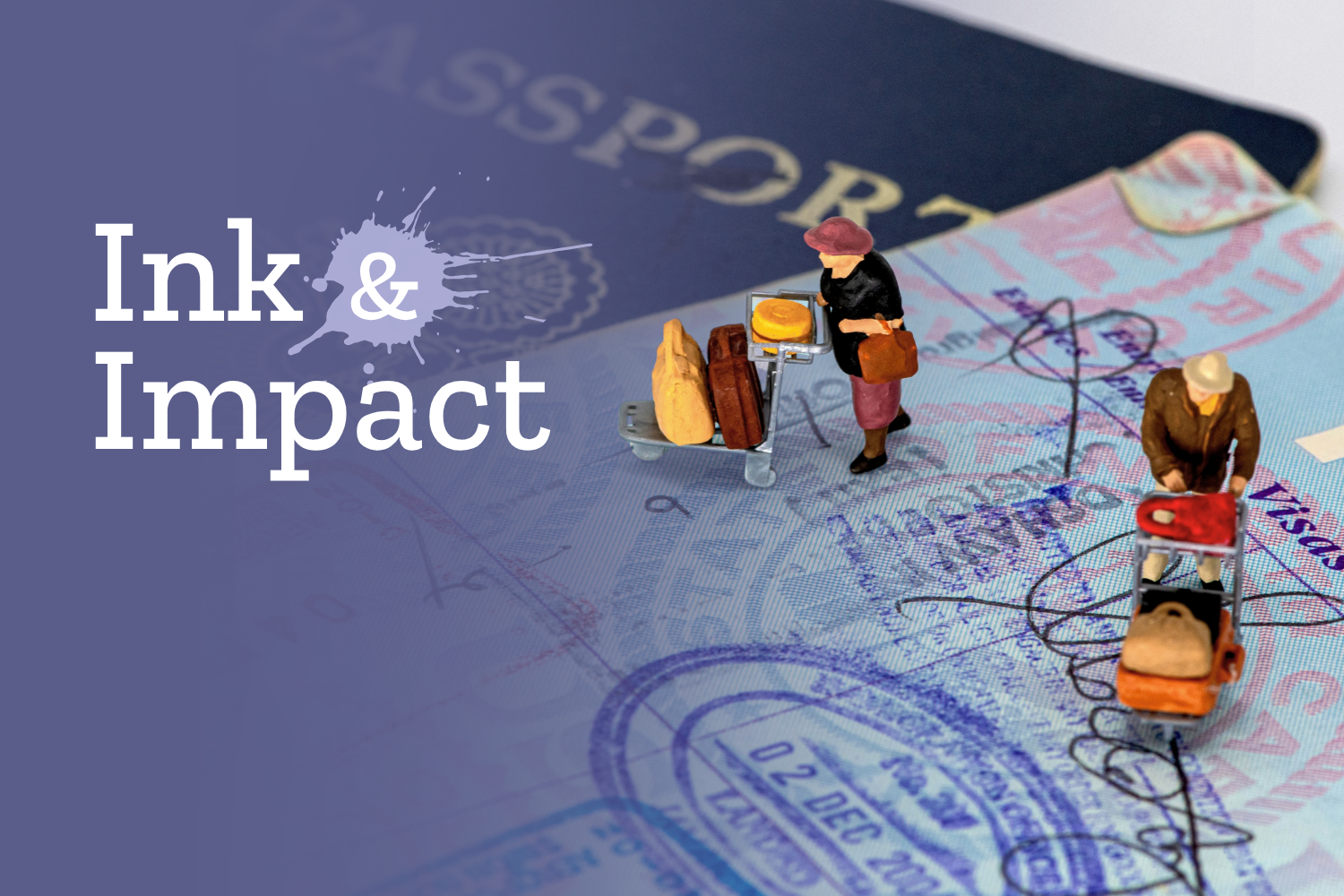
This article is the fifth in CPJ’s Ink & Impact series featuring young writers from across the country. In today’s political climate, often marked by cynicism and despair, CPJ’s annual Ink & Impact conference helps Christian young people become messengers of hope. In a world dominated by digital distractions, Ink & Impact develops writers who can articulate complex political topics in an approachable, nuanced way to inform the public. The views and opinions reflected in these articles are those of the authors and do not necessarily reflect the official position of CPJ.
Names and identifying details of this story have been changed to ensure anonymity.
Ngozi tapped the “end call” button and buried her face in her hands. Her sister, still living at home in Nigeria, had just informed Ngozi that her visa application had been denied, gutting their dreams of attending an American university together. For months, Ngozi had been eagerly anticipating the day when her sister would arrive on campus. She would force her sister to join the gospel choir. They would complain about American grocery stores and make jollof rice and suya together. But after months of bureaucratic mechanisms, confusing guidelines, and changing regulations, a single moment in November 2025 brought their hopes and plans to an abrupt halt. For Ngozi’s sister, the gates of America were shut.
Months prior, Ngozi’s sister had applied and been accepted to Ngozi’s university, the first step in obtaining an F-1 student visa. She had diligently pursued a visa interview and paid all her fees, only for the U.S. State Department to pause all new interviews for student visas in May 2025. When applications opened again, the backlog of students was so overwhelming that Ngozi’s sister could not get an interview until November, three months after she had hoped to begin her studies in the United States. And after all that, her application was denied. On January 1, 2026, Nigeria was listed among the 75 countries barred from obtaining student visas to the United States. As of September 2026, the ban is still in place.
According to Open Doors Data, just under 1.2 million international students enrolled in undergraduate and graduate programs in the United States in the 2024-25 school year, about 6% of the total U.S. higher education population. This surpassed the pre-pandemic record of 1.1 million international enrollments reported in 2019. These students contribute richly to their academic programs and campus life. Through student organizations, on-campus jobs, leadership, and research, international students strengthen their campus communities. They embody the promise of diversity and multicultural learning that is among the United States’ greatest strengths.
Obstacles to the Land of Opportunity
Many international students in the United States have faced increasing pressures as visa requirements have tightened over the past year. Where some might have once felt welcome, many now navigate a climate of uncertainty or suspicion. The consequences are already visible. In 2025, Forbes reported a nearly 50% drop in international students coming to the United States from India. George Washington University enrolled nearly 400 fewer international students than expected for the 2025-2026 school year.
Recent changes to the student immigration system limit access to and the experience of higher education in the United States. Visa applicants must now set their social media accounts to “public” to be scanned for anything that suggests political contention or anti-American sentiments. Prospective and current international students find themselves navigating their political expression with great caution, aware that public statements or activities could draw attention and affect their visa status.
In the past, students on an F-1 visa also enjoyed “duration of status,” meaning that they could remain in the United States as long as they were enrolled in an educational program. Under the current administration, that provision has been removed. According to the Department of Homeland Security, duration of status allowed “foreign students” to take “advantage of U.S. generosity” and overstay their welcome “much to the detriment of U.S. citizens and taxpayers.” Now, student visas often have a fixed four-year term. Upon expiration, a student must return to their home country or apply for a different extension, which is extremely difficult to obtain.
In some cases, visa durations are even shorter. Had Ngozi’s sister’s visa application been approved, it would have been valid for three months. After its expiration, she would have been allowed to remain in the United States as long as she was enrolled in her undergraduate program and did not leave American territory. Under these new requirements, applying for master’s programs is a significant financial risk. Going home for holidays or summer breaks is out of the question. For many international students, the experience of studying in the United States has shifted from one of opportunity to constant awareness of a precarious status, demanding careful navigation and constraint.
Why Should We Care?
There are practical reasons why Americans ought to take notice of these systemic changes. International students contribute to the economy by paying tuition dollars—often far more than domestic students—and buying American goods. Welcoming international students is an excellent form of soft diplomacy, promoting healthy global relationships and a positive view of America abroad. International students also enrich academic research by diversifying the pool of thought, offering unique perspectives and solutions to complex problems. The entire world benefits when the brightest minds from across the globe have access to high-quality education, research funding, and technology.
These practical considerations matter. But as Christians, our concern runs deeper. As citizens of a heavenly kingdom, we are called to pursue multicultural understanding and resist isolationism. God created a family of faith from every tribe, tongue, and nation (Revelation 7:9), and as image-bearers of God we ought to reflect the multicultural kingdom of God whenever we can (Colossians 3:11). We must practice the virtues of hospitality, humility, and grace, denying any inherent superiority based on nationality. If we believe that our earthly educational resources are given to us by God to help further God’s kingdom, why should we restrict access to them or be territorial about them, denying those who wish to grow in knowledge and wisdom? We cannot live in fear, assuming that those from other nations mean to do us harm. Rather, we must have compassion for international students living under immense strain and for those whose dreams of building better lives or following the vocational calling God has placed on their hearts have been constrained by tightening migration policies.
A Kingdom-Minded Response
CPJ’s public justice framework explains that government is called to create and enforce legislation that protects all within their jurisdiction. This includes visitors to the country. While government has the right to establish policies regulating entry into its territory, it also owes its own citizens a commitment to promote the common good, which includes fostering international and intercultural relationships. Citizens and civil society play a vital role in holding government accountable to that calling, advocating for policies that promote justice, flourishing, and equal opportunity for all.
Americans can engage their representatives and make their voices heard on student immigration policy. Individuals can also get involved with one of the many nonprofits doing advocacy work on this issue, which unite educators, administrators, and domestic students in support of their international peers. Christians can encourage their local churches to offer support services for international students in their area, particularly around the holidays or vacations when students are unable to return home. Lastly, universities should provide legal resources for international students, offer training on navigating their visa status and understanding their legal rights, and ensure that emotional and mental support is available as the burdens of stress and homesickness take their toll.
Ngozi’s senior year of college was difficult. She missed her family. She was uncertain about how her future might be constrained by her visa status. And yet, she found strength in her university’s international community, which gathered together for solidarity, resource-sharing, and encouragement. When joined by domestic students, Ngozi could be reminded that she was not a stranger in a foreign land, but someone with talent, intelligence, and compassion, using the opportunities given her to contribute to God’s kingdom work.
Throughout Scripture, God promises to bring all the nations of the world into the eternal family. We believe that one day all peoples, tribes, and tongues will be united in praise of the Creator and Sustainer of all things. As Christians and sojourners on earth, we seek glimpses of the kingdom in our present moment. This means that we reject isolationism and welcome people of all nations into our kingdom-building work. With that posture of hospitality and multicultural fellowship, we must also continue to welcome international students with open arms. In so doing we also honor the glorious variety of God’s family. We follow the commands of Jesus to care for the foreigner and the stranger, and we catch a glimpse of the kingdom to come.
Meg Pheifer is a recent graduate of Calvin University, where she studied history, political science, and urban studies. She is currently living in Bangkok, Thailand as an intern for International Justice Mission, a faith-based organization working to systemically and prayerfully end violence against the world’s poor. After her time in Bangkok ends, Meg plans to pursue a Master’s degree and build a career in the civil service sector.
Graphic by Center for Public Justice