This article is the second in CPJ’s Ink & Impact series featuring young writers from across the country. In today’s political climate, often marked by cynicism and despair, CPJ’s annual Ink & Impact conference helps Christian young people become messengers of hope. In a world dominated by digital distractions, Ink & Impact develops writers who can articulate complex political topics in an approachable, nuanced way to inform the public.
Factory Farming and Its Costs
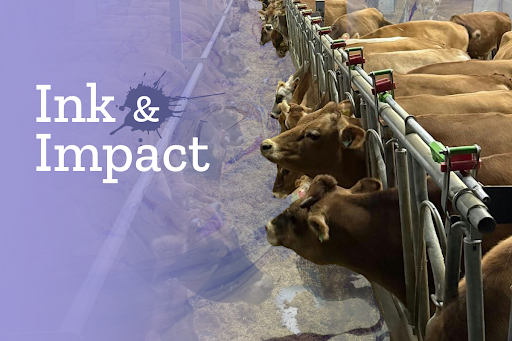
99% of all animals eaten or used to produce milk and eggs in the United States are factory farmed. As Jonathan Safran Foer writes in Eating Animals, “to speak about eating animals today is to speak about factory farming.” Within CAFOs (Confined Animal Feeding Operations), nearly 80 billion land animals are bred, confined without space, genetically modified, and slaughtered each year for the sake of expediency and profit maximization.
CAFOs also pose significant risks to environmental and human flourishing. The animal agriculture industry accounts for 32% of methane emissions worldwide, and CAFOs produce 13 times more waste than the entire population of the United States. They are also breeding grounds for antibiotic and zoonotic disease—consider the 1,700 outbreaks of avian influenza from poultry farms since 2022.
More than 70% of Americans oppose common factory farming practices. Yet advocacy and reform efforts remain significantly underfunded compared to the scale of harm. In 2024, U.S. giving for environmental and animal causes reached an all-time high of $21.57 billion. The global meat market generated approximately $1217.95 billion in revenue in 2025—McDonald’s alone brought in $27.4 billion that year—dwarfing the resources dedicated to reform.
Many people hold back because they believe the only meaningful step available to them is altering their diet. Becoming vegan or vegetarian is a massive lifestyle change with high rates of recidivism, and eating non-factory farmed meat—whether humanely raised or lab-grown—can be costly.
That’s where organizations like FarmKind disagree. I spoke with Thom Norman, Co-Founder and Executive Director of FarmKind, to learn new ways for citizens to engage with this issue.
Founded in early 2024 by Norman and Aidan Alexander, FarmKind reframes food ethics from “What should I eat?” to “What food system am I supporting?” Funded entirely by philanthropic grants, FarmKind identifies and curates the most effective charities making a difference against factory farming—by reducing animal suffering and creating alternative systems—and recommends them to users. They make giving easy to organizations that phase out cruel practices, persuade governments to move toward kinder and more sustainable food systems, and help companies produce food without factory farming.
FarmKind also helps quantify meaningful donation amounts. Their “Compassion Calculator” tool shows users how many animals are impacted by their diet, suggesting a donation amount to help offset the effects of their consumption. Norman noted that the average donation amount needed to make a significant impact is far lower than most people expect—approximately $23 to the right charities can accomplish as much as going completely vegan.
“You don’t have to change your diet to be able to make a really big difference,” Norman said. “You can donate and then we all show you how much good you’re doing, because donating can be just as effective—or more effective—than changing your diet depending on how much you give and to where.”
Creatures, Not Commodities
Most people imagine farming as managing land and caring for animals in order to feed communities. This intuition aligns with biblical depictions of humanity before the Fall, where in Genesis 2 humanity was called to name the animals, till the land, and to keep the earth as its stewards. Scripture holds high regard for animals, reflecting their place within God’s created order:
“Know well the condition of your flocks and give attention to your herds” (Proverbs 27:23, New Revised Standard Version).
“The righteous know the needs of their animals, but the mercy of the wicked is cruel” (Proverbs 12:10).
“You shall not muzzle an ox when it is treading out the grain” (Deuteronomy 25:4).
God’s design values animals as fellow creatures with inherent value, not as units of production. Their role within our food systems is to contribute to human and ecological flourishing, not profit maximization. Yet because of the Fall, this design has been fractured for the sake of economic scale over creation care.
“There is overwhelming scientific evidence that ways of keeping animals in factory farms cause them both physical and mental suffering to quite an extreme degree,” said Norman, who is also a Christian. “Factory farming is also massively destructive for the environment and is putting human health at risk on a really systematic global scale.”
“Even if you don’t care about animals—and I think there are good reasons to care about animals—and only care about humans … factory farming is still something you want to avoid if you can.”
Creation Care as Public Justice
The Center for Public Justice’s guidelines on the environment assert that creation’s vast diversity holds together as an “interdependent unity”: “That which is not human has its own identity and purpose by God’s design and does not exist merely as a means for human ends. Consequently, ecological carefulness should be a condition of all development.”
Norman said something similar: “Stewardship or dominion does not mean you can do whatever you want with animals, and there’s certainly no implication that you can use animals as objects.”
Government and civil society, including nonprofits like FarmKind, are called to restore a creational vision that treats all creatures as ends in themselves. In cultivating societal flourishing, we must remember the interdependent unity we hold with all creatures. At the federal level, legislation such as Senator Cory Booker and Representative Ro Khanna’s Farm System Reform Act illustrates one approach to addressing factory farming systemically, placing a moratorium on new CAFOs and calling for existing ones to cease operation by January 1, 2041.
So, what next?
At the policy level, Christians and citizens can support legislation that addresses the effects of factory farming, including standards around animal confinement, sale bans, and moratoriums on the creation of new CAFOs.
If alternatives are available, buying meat outside of this industry, or reducing meat consumption altogether, is one meaningful step. For those who cannot or choose not to change their diet, organizations like FarmKind offer another avenue for engagement. As of 2026, FarmKind’s partner charities have helped 4.6 million animals, as well as over half a billion shrimp.
As Norman notes, you are not a bad person if you do not change your diet.
“For those people who have got disposable income who are able to donate,” he said, “this is a really, really impactful way to make your donations make a really big difference in the world, to prevent a huge amount of suffering, to help a lot of animals, and to help genuinely fix a really big challenge for our society.”
Failing to address factory farming as a problem undermines our duty to steward God’s creation. Either through altering our diet or advocating for systemic reform, let’s honor this biblical responsibility.
Grant Dutro is Editorial Project Coordinator at Christianity Today. He lives in Nashville, TN, and is pursuing a master’s of theological studies at Vanderbilt Divinity School. He was the Summer 2025 Communications Intern at the Center for Public Justice.
Graphic by Center for Public Justice