Sitting in a Catholic Mass in 1996, John Dilulio had what he later described as an epiphany. Months earlier, the Princeton professor had coined the term “superpredators” in a November 1995 Washington Examiner article to describe his predictions on youth crime rates. Now, he resolved to change his focus, advocating for a preventative approach to addressing youth crime. DiIulio would go on to submit an amicus brief in support of the petitioners in Miller v. Alabama, the Supreme Court case that established that life sentences without the possibility of parole for youth is unconstitutional.
Understanding the significance of this moment requires a close examination of how language shapes public reasoning about social issues, as well as the history of the “superpredator” theory and the reaction that followed.
The metaphors and imagery we use shape how we understand complex issues. Research by Stanford University professors Paul H. Thibodeau and Lera Boroditsky provides empirical evidence that the way a problem is described can significantly influence how people believe it should be addressed. In their study, participants read a paragraph on crime in a hypothetical city, with identical statistics but different framing. One version described crime as a “beast,” using language like “wild” and “lurking,” while the other described it as a “virus,” with terms like “infecting” and “plaguing.” Participants were then asked whether they would recommend solving crime through enforcement and punishment or through reform and rehabilitation. Those who read the “virus” framing were more likely to favor reform and rehabilitation-oriented solutions compared to participants whose version presented the “beast” framing.
This phenomenon extends beyond laboratory settings. Academic discussions, media coverage, and policies related to youth crime in the 1990s illustrate the trends identified in Thibodeau and Boroditsky’s research unfolding on a large scale.
In the 1980s and early 1990s, the United States experienced near-unprecedented rates of crimes committed by youth offenders, including violent crimes. National data from the Federal Bureau of Investigation, analyzed by the Urban Institute, shows that the rate of juvenile (under 18) arrests for murder increased 167% between 1984 and 1993.
The language used to describe this problem shaped political and public responses. Terms like “wilding,” “wolf packs,” and other animalistic, often racially charged terms became common in the national vocabulary. Politicians, news outlets, and justice system leaders spoke frequently and severely on “soft-on-crime” policies and warned of out-of-control youth criminals. Headlines across the country reported on the death of Robert “Yummy” Sandifer, an 11-year-old gang member who was murdered by a teenager in Chicago after he killed a 14-year-old girl. Other stories of youth violence, many of which received extensive sensationalized media attention, contributed to heightened public panic about reportedly remorseless, violent, and heavily armed teenagers and children roaming the streets.
Amid this climate, criminologists and academics—most famously among them Professors James Wilson, James Fox, and John DiIulio—forecasted that rates of violent youth crime would continue to skyrocket. In his now-infamous 1995 Washington Examiner article, “The Coming of the Super-Predators,” DiIulio predicted that by 2000, there would be more than 30,000 additional violent juvenile criminals on the streets, and that this new generation of youth offenders would be three times as dangerous as the one that came before it. He attributed the rise in juvenile crime to both population growth and “moral poverty,” arguing that these children were growing up without moral role models to teach them right from wrong. Dilulio captured his prediction in stark terms:
On the horizon, therefore, are tens of thousands of severely morally impoverished juvenile super-predators. They are perfectly capable of committing the most heinous acts of physical violence for the most trivial reasons (for example, a perception of slight disrespect or the accident of being in their path). They fear neither the stigma of arrest nor the pain of imprisonment.
The term “superpredator” and its widespread usage by politicians and the media alike became a catalyst that came to define much of the decade’s juvenile justice policy and rhetoric. In the same Washington Examiner article, DiIulio advocated for punitive measures: “By my estimate, we will probably need to incarcerate at least 150,000 juvenile criminals in the years just ahead. In deference to public safety, we will have little choice but to pursue genuine get-tough law-enforcement strategies against the super-predators.”
These predictions, combined with many highly publicized juvenile crime stories, were associated with legislative changes in nearly every state and the District of Columbia that made it easier to charge juveniles as adults and impose harsher penalties. In some states, the consideration of youth was removed altogether, replacing discretionary sentencing with compulsory ones, including mandatory life without parole.
Yet many of the predictions made never came true. By the time DiIulio’s article was published in 1995, rates of violent juvenile crime were already declining. By 2000, they had fallen below 1985 levels. States had braced for a crime wave that never came, resulting in policies that often treated youth harshly without a proven basis. In an interview reflecting upon his theory and its mainstream traction, Dilulio admitted, “the superpredator idea was wrong. Once it was out there, though, it was out there. There was no reeling it in.” And taken on its own life it had. High profile politicians, from first lady Hillary Clinton to presidential candidate Bob Dole, used “superpredator” language. National news networks went from running around 500 crime stories per year in the early 1990s to over 2,500 in 1995, according to one study.
Since the height of the so-called superpredator era, progress has been made while some problems continued. Research indicating the effectiveness of diversion programs and alternatives to a wholly punitive approach in many cases have reinforced the importance of systemic reform within juvenile justice. In 2005, the Supreme Court banned the death penalty for juvenile offenders, and in 2012 ended mandatory juvenile life without parole (notably with DiIulio’s support). While systemic issues and harsh public perceptions lingered, and continues to do so, many states also made efforts to implement evidence-based reform practices.
Despite the lessons of the 90s and scientific research since, similar rhetoric has reappeared in recent public discourse. In an August 2025 news conference, President Trump warned of “caravans of mass youth” on a “rampage through city streets at all times of the day,” He spoke of “roving mobs of wild youth” and directly addressed reporters, saying “you people are victims of it too… you don’t want to get mugged and raped and shot and killed.” The United States Attorney for the District of Columbia commented, “I see too much violent crime being committed by young punks who think that they can get together in gangs and crews and beat the hell out of you or anyone else.”
This rhetoric does not exist in a vacuum. Rather, it has tangible policy consequences. In September 2025, the House of Representatives passed a package of bills that counter many widely accepted juvenile reform practices. The legislation is now pending in the Senate. One bill lowers the age at which youth can be tried as adults for certain offenses; another imposes mandatory sentencing minimums, limiting judicial discretion by requiring judges to abide by minimum prison terms for various offenses set by prosecutors. Treating youth as adult offenders by funneling them into the adult criminal justice system has significant implications: youth placed in adult jails are at greater risk of sexual abuse and are 36 times more likely to commit suicide compared to youth housed in juvenile facilities.
These policy proposals stand in tension with a strong body of evidence, indicating that rehabilitative and treatment-oriented approaches are effective in reducing youth crime. Not only are these programs more economically efficient, but there is empirical data that these treatment models reduce recidivism rates by 12% to 35%. Meanwhile, studies associate punitive measures with an increase in the likelihood of recidivism. A 2011 review of youth released from residential correctional facilities noted that 70% to 80% were rearrested within two to three years, illustrating the ineffectiveness of solely punishment-oriented approaches. The connection between the rhetoric of the current administration and recent legislation should not be overlooked, nor its parallels to language and legislation of the late 20th century.
What is often overlooked in Dilulio’s work, however, is his emphasis on the role of churches in addressing and preventing youth crime. In his original Washington Examiner piece, he referenced the church’s responsibility to support vulnerable youth. Following his epiphany, Dilulio, as the first director of the White House Office of Faith-Based and Community Initiative, advocated for increased federal funding for church programs. He supported faith-based diversion efforts and encouraged churches to serve as safe and healthy environments where youth could find positive role models.
All of this raises a broader question: if sensationalized language in policymaking can distort justice, what vision sustains a more faithful response to youth crime? Public justice at its core is a vision of shared responsibility among diverse institutions—public and private, faith-based and secular—in pursuit of human flourishing. The Center for Public Justice holds that government has a responsibility to recognize and protect both individual and institutional rights, including the rights of families and their children involved in the justice system. Policies that result in prolonged or permanent family separation raise serious concerns about the proper exercise of government authority, the well-being of children, and the moral integrity of public life.
A Christian framework deepens this vision by grounding justice in both mercy and human dignity. Scripture and tradition emphasize care for the vulnerable and affirm human identity as image-bearers of God. Viewing justice-involved youth through this lens calls for responses that prioritize restoration and support rather than solely punishment. This does not come at the expense of pursuing justice for victims of youth crime.
Rather, a faithful pursuit of justice and mercy includes acknowledging and addressing the underlying factors that contribute to youth crime and ensuring that young people receive holistic support.
It also recognizes what psychological research and Supreme Court precedent have affirmed: youth have a unique capacity for change and growth. A comprehensive vision of juvenile justice, therefore, holds together multiple dimensions of justice that are not mutually exclusive.
Though it certainly extended beyond him, Dilulio’s contributions to the superpredator era and after serve as both a warning and as a beacon of hope. Language matters. How we speak about children affects public perception and policy, and may even reinforce the very behavior it seeks to deter. Labeling theory, which undergirds support for youth diversion and rehabilitative approaches to juvenile justice whenever justice and public safety allow, argues that individuals tend to internalize labels placed on them, potentially acting in ways that reinforce these stigmas. If the goal is to reduce crime, policies must affirm human dignity and be informed by evidence-based practices that provide holistic support and rehabilitation to youth.
At the same time, Dilulio’s willingness to publicly change his position and advocate for a different approach offers a model of humility. It demonstrates that even deeply influential ideas can be reevaluated, and that meaningful change–both personal and systemic–is possible and impactful.
Public justice, then, requires a commitment to both public safety and the well-being of young people, recognizing their vulnerability as well as their capacity for growth. Christian values of justice, mercy, and care for the vulnerable provide the foundation for engagement in juvenile justice—one that is mindful of the impact of rhetoric, recognizes the humanity of justice-involved youth, and supports policies in line with these values. From youth caught in cycles of violence to administration officials and legislators, there is hope for us all. No one is beyond redemption, and just policy must reflect that.
Mary Lauren Veazey was a Research Associate at the Center for Public Justice during her time in the Capital Fellows Program. She graduated from Duke University with degrees in Psychology and Public Policy. Mary Lauren is passionate about the intersection of children’s mental health and public policy and hopes to one day work in the field of clinical psychology.
Rosalind Niemeier is the Policy Associate at the Center for Public Justice. She graduated from Calvin University with a BA in International Relations and Spanish. From 2024 to 2025, she served as the Communications Associate at the Center for Public Justice.
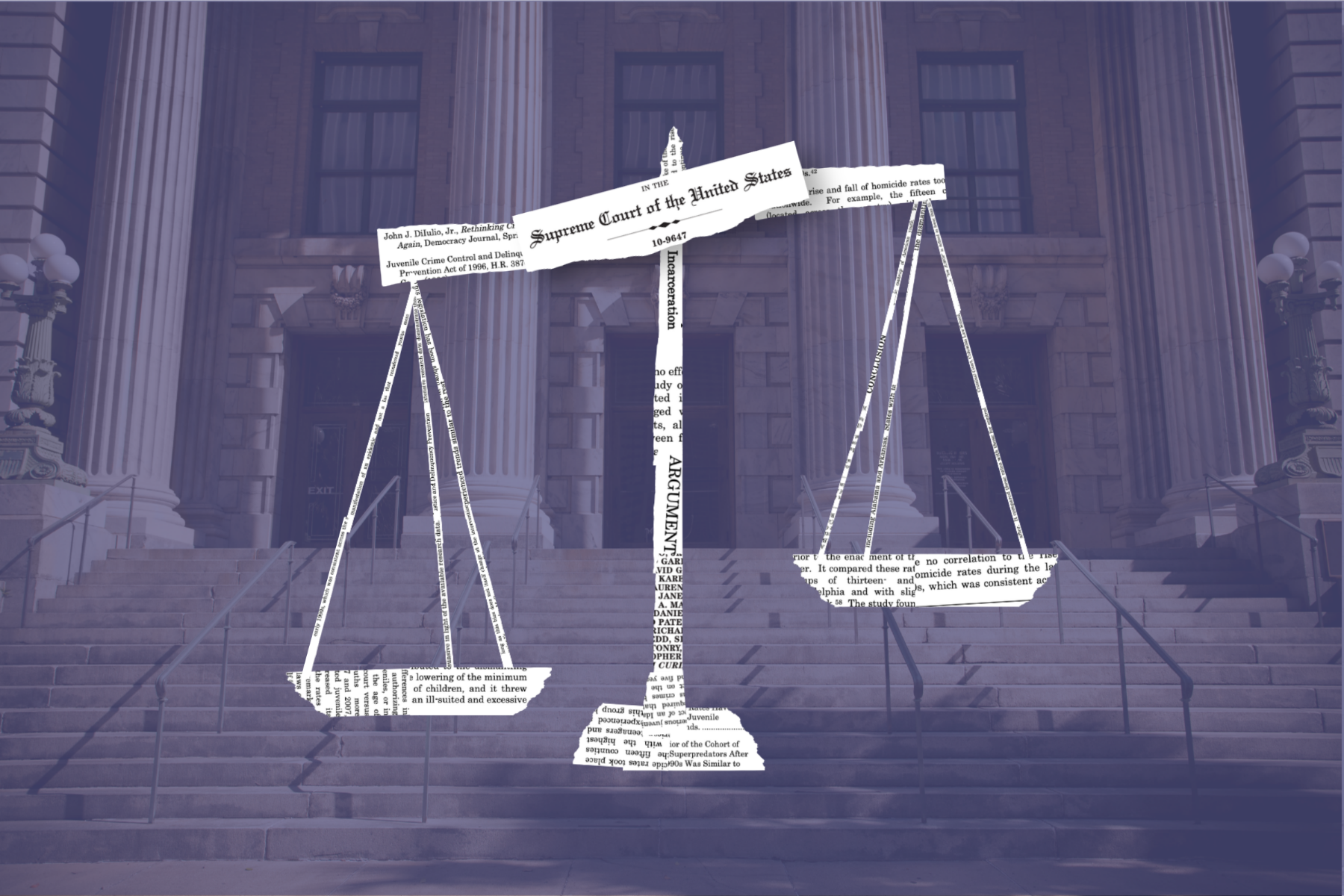
Graphic by Center for Public Justice / Source Photo by Pgiam from Getty Images Signature, accessed with Canva Pro.