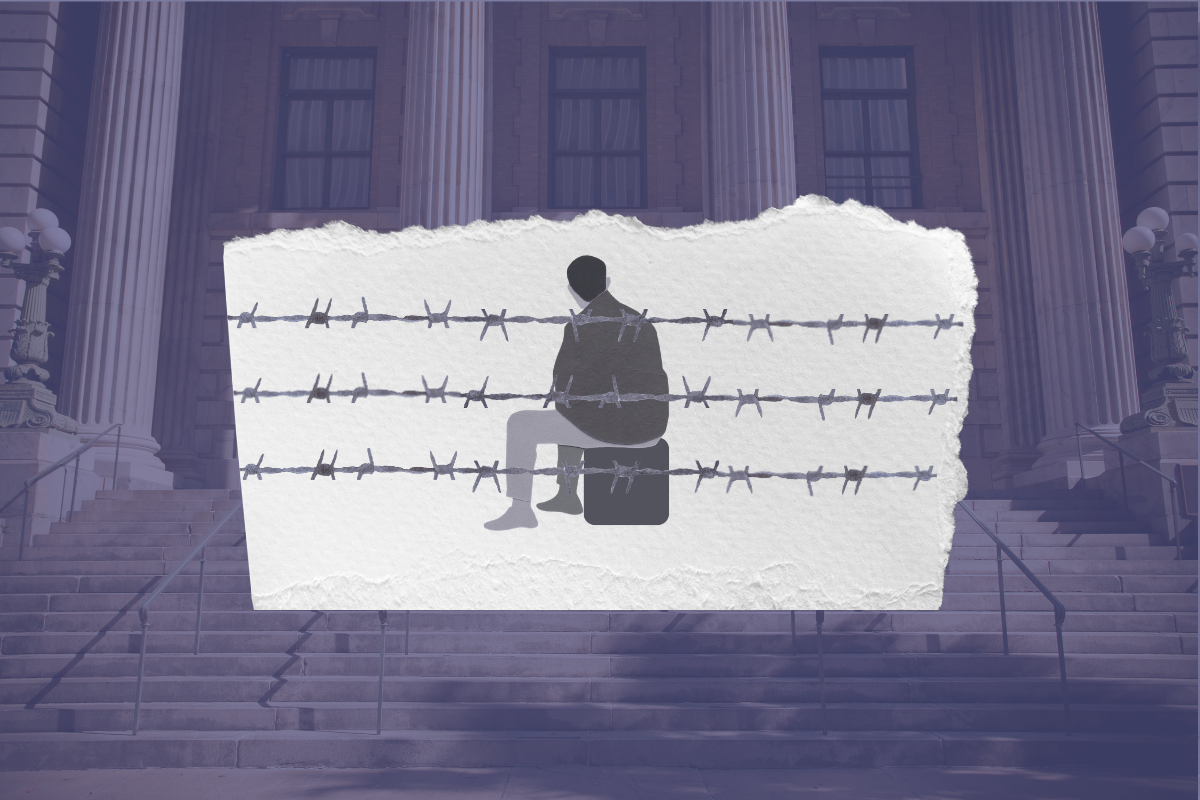
At 16 years old, Edward Simms stood in a Virginia courtroom and was told by a judge that he was ‘irredeemable.’ Raised in a single-parent household by a mother who had him while she was still a minor, Simms experienced an unstable childhood. He left home at age 12 to live with his aunt, who later went to prison. At 16, Simms was arrested after committing three armed robberies in the span of a few weeks. Due to Virginia’s newly enacted three-strikes law, he was declared ineligible for parole and sentenced to life in prison.
Think back to your own teenage years. Does that version of you fully reflect who you are today? Modern neuroscience suggests otherwise. Research from the National Institutes of Health indicates that the average human brain doesn’t fully develop until around age 25. Adolescents are particularly vulnerable to impulsive decision-making, in part because of a psychological tendency known as sensation seeking, which leads young people to pursue thrilling and exciting experiences without fully considering consequences. A 2007 National Annenberg Survey of Youth found that sensation seeking peaks around age 19 for men and 16 for women, declining considerably as adolescents reach their early 20s. This suggests that the impulsive decision-making brain patterns common in adolescents don’t last into adulthood, highlighting a strong capacity for change and maturation. If change is not only possible but likely, sentencing a juvenile to life without parole (JLWOP) ignores this reality entirely.
Life without parole is, in effect, a death sentence. It means that no matter what a person does in prison, no matter how well they behave or how much they change, they have no hope of release. JLWOP is particularly cruel given adolescents’ unique capacity for change and maturation.
Edward Simms was in prison for 32 years before being released, nearly 50 years old, after Virginia changed its three-strikes law and made him eligible for parole. According to his attorneys, Simms was a “model inmate” and had zero infractions during his final 20 years in prison. He also engaged with local communities as a tutor, desperate to improve the lives of others. Edward Simms’ story demonstrates how capable juveniles are of real transformation.
How We Got Here: Crime, Fear, and Policy
The roots of JLWOP run back to a period of rising public concern about violent crime. During the 1980s and 1990s, violent crime rose significantly, with the majority of crimes being perpetrated by young people under the age of 25. According to the Urban Institute, the juvenile arrest rate for violent offenses increased 64% from 1980 to 1994, and the arrest rate for murder alone jumped 167% from 1984 to 1993. In response, state and federal governments enacted numerous crime control policies: three-strikes laws, bans on assault weapons, harsher mandatory minimums, and a decrease in the age at which a juvenile can be tried as an adult for a violent offense. It was during this wave of crime control laws that sentencing juveniles to life without parole became far more common.
These policies also had a disproportionate effect on minority communities, particularly Black youth. The expansion of three-strikes laws and the overpolicing of Black neighborhoods resulted in a massive increase in incarceration rates. According to the Bureau of Justice Statistics, the U.S. Prison Population rates rose from nearly 330,000 in 1980 to over 1.6 million in 2009, an increase of almost 400%. These rates vary substantially by race, with Black Americans being five to six times as likely to be imprisoned as white Americans as of 2009.
Why Faith Demands We Pay Attention
These failures were not inevitable. They reflect a deeper breakdown in how our society values the lives of its most vulnerable young people. Juvenile life without parole treats minors as irreparable problems, giving them no hope to re-enter society. Scripture makes clear that God’s people are called to care about and be advocates for justice in our communities. Isaiah 1:17 commands us to “seek justice” and “correct oppression,” and Deuteronomy 32:4 reminds us that we serve a just God whose works are perfect. As we are all created in God’s image, we possess an inherent dignity that the justice system is called to uphold. Sentencing minors to life without parole violates that dignity by rejecting the possibility of repentance and transformation. If the thief on the cross could turn from his sin and embrace Christ, how much more should we recognize the possibility of change in young people whose lives are still unfolding? As a community of believers, we are called to forgive those who trespass against us, including those caught in the criminal justice system. Rehabilitation only works when communities open their arms to the vulnerable and allow them to heal and re-enter society.
The Obligations of Government
These theological truths don’t stop at personal transformation; they also shape how we understand the role of government. Government has God-given authority to promote the common good and restrain wrongdoing. Public justice recognizes that government is not the only institution responsible for human flourishing—families, churches, nonprofits, and communities each carry their own obligations. At the same time, since we live in a broken world, even well-intentioned institutions can fall short of that calling and fail to protect those whom they serve.
Since the early 2000s, federal and state governments have taken meaningful steps to reverse the harmful crime control policies of decades prior. In 2010, the Supreme Court ruled in Graham v. Florida that sentencing a juvenile to life without parole for a nonhomicide offense was unconstitutional under the Eighth Amendment’s prohibition on cruel and unusual punishment. Two years later, in Miller v. Alabama, the court held that mandatory JLWOP sentences are also a violation of the Eighth Amendment. In 2016, the Supreme Court’s ruling in Miller was made retroactive by Montgomery v. Louisiana, allowing individuals sentenced to JLWOP to become parole eligible. While these rulings did not ban JLWOP entirely, they placed severe restrictions on when such a sentence could be administered. To this day, a complete ban would likely require significant further legal or legislative action at the federal level. Still, as of 2026, 28 states have banned JLWOP, beginning with Kansas in 2007, and many states where it remains legal no longer have individuals serving such a sentence.
Rehabilitation Over Retribution
Given what neuroscience, lived experience, and Scripture all make clear, that young people are capable of profound change, the question is not whether juveniles can be rehabilitated, but how the justice system should respond. Criminal sentencing typically pursues one of three goals: retribution, deterrence, or rehabilitation. Retribution focuses on punishment, while deterrence seeks to discourage future crime by making an example of offenders. Rehabilitation, however, aims at transformation, equipping individuals to return to society as contributing members. For juveniles, sentencing should reflect their demonstrated capacity for change.
According to the Boston Bar Association, the primary goal of sentencing for all juveniles should be rehabilitation. In an article published by the Department of Justice’s Community Oriented Policing Services, rehabilitative sentences can be divided into four stages of support: prevention, intervention, out-of-home placement, and community reintegration. The prevention stage focuses on identifying youth deemed as ‘high risk’ and providing them with the proper mentorship and care. The intervention stage aims to provide similar resources to youth who may already be caught in the criminal justice system, including “juvenile and family treatment courts…community violence intervention (CVI), and cognitive behavioral therapy.” Out-of-home placement occurs when a juvenile is sent to live outside their family home in a more stable environment, such as a foster home. Finally, community reintegration provides educational and mental health resources upon exiting the justice system, setting youth up for future success and employment.
Rehabilitative approaches place significant emphasis on prevention, which lowers a juvenile’s likelihood of committing future offenses. While rehabilitative programs are generally more costly than traditional incarceration, that cost must be weighed against the long-term human costs of permanent incarceration for juveniles. JLWOP eliminates the possibility of restoration.
When the System Can’t Do It Alone
While government has a vital role to play in ending JLWOP and promoting the rehabilitation of youth in juvenile detention, civil society can likewise make a massive impact. Scott Larson, president and CEO of Straight Ahead Ministries, has spent decades working with incarcerated youth. In a conversation with the author, Larson emphasized that many of the juveniles he works with are eager for change, and view Straight Ahead as “a support, and even [a] family.” That relationship doesn’t end at 18 or even 21, as Straight Ahead stays with young people well into adulthood, seeing them as future leaders with incredible potential, not a “problem to fix.”
Crucially, all of Straight Ahead’s programs are voluntary, allowing youth to choose participation. Straight Ahead also frequently relies on “reentry staff [who] live in the same communities” and share similar backgrounds to those they serve, allowing them to relate to one another’s experiences and be seen by incarcerated youth as “true credible messengers.” Over four decades of this work, the organization has built deep trust with the juvenile justice system itself, becoming a valued partner able to do “many of the things they are not able to do because of their mandates.” This is public justice in practice: government and civil society each doing what they are uniquely positioned to do, working toward outcomes neither could achieve independently.
Juvenile life without parole is a death sentence. It denies the possibility of transformation and fails to uphold the dignity inherent in every human being. Young people are capable of change, and the justice system should reflect that reality. Edward Simms spent 32 years behind bars before Virginia’s law changed to reflect what his own conduct had long demonstrated: that people change, and that young people especially deserve the chance to prove it. A just society does not treat its children as irredeemable, but gives them the opportunity to change.
Kayin Robbins is a second-year undergraduate student at American University studying CLEG (Communications, Law, Economics, Government). He hopes to pursue higher education after graduation and fulfill a calling to work as an advocate for marginalized individuals entangled within the criminal justice system.
Graphic by Center for Public Justice / Source Photo by Pgiam from Getty Images Signature, accessed with Canva Pro.