
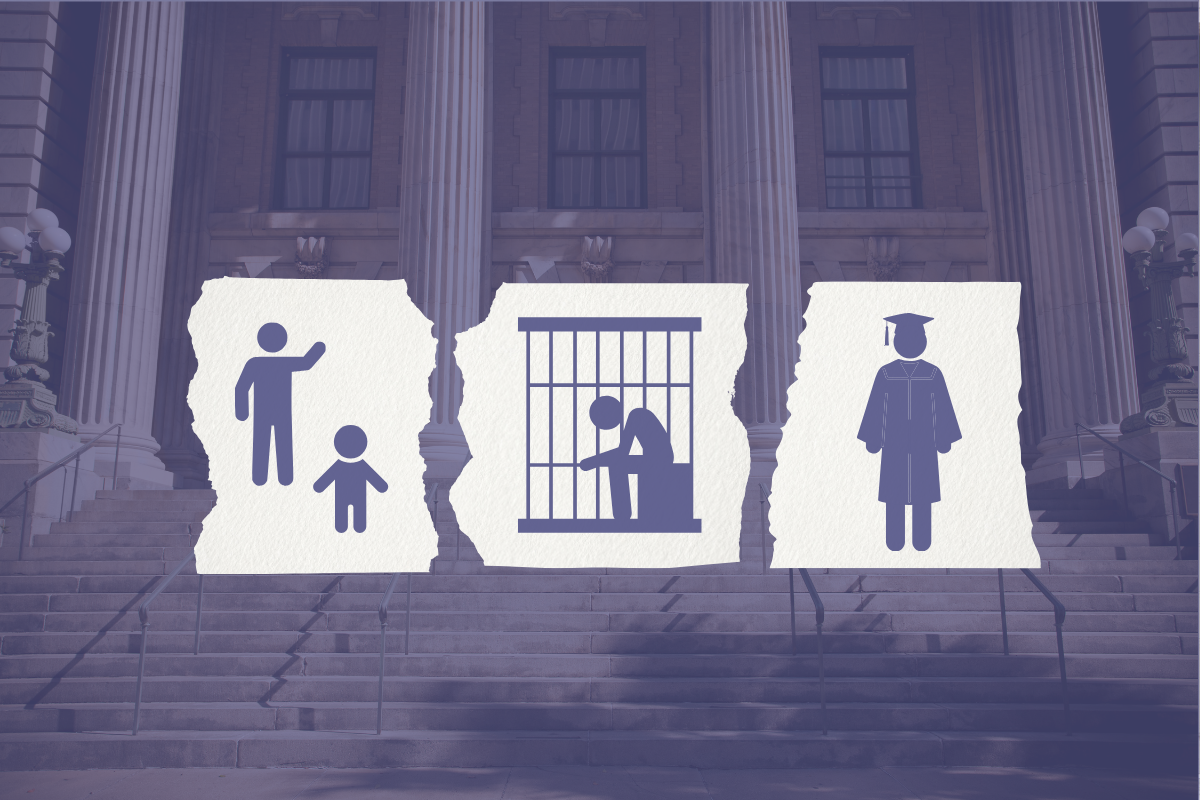
Dionntai Holyfield is a 2026 graduate of Wheaton College, where he studied Psychology and Anthropology. He graduated summa cum laude and was the 2026 recipient of the J. Richard Chase Award of Merit. At the age of 16, Dionntai was convicted of a felony and tried as an adult, receiving an 18-year sentence in Ohio. He was released two years early in 2022 at the age of 31.
Naomi Thompson, a sophomore Urban Studies major at Wheaton College, leads a ministry at a local juvenile detention facility. She sat down with Dionntai to hear his story.
This is Part 1 of a two-part interview that was conducted on April 22, 2026.
Editor’s Trigger Warning: This interview contains references to child abuse, sexual assault, and suicidal ideation.
To begin, can you tell us a little bit about your upbringing?
I was born in Toledo, Ohio, in a mostly impoverished community. Drugs and alcohol were around. My grandmother had lost custody of my mom and her siblings. She struggled with addiction, and that really took a toll on her children’s lives. They grew up in foster care, and as they got older, they didn’t turn out well. My mother in particular.
She passed away when I was five years old from the AIDS virus. After that I went into foster care, because my grandmother had already lost custody and wasn’t permitted to take in more children. Two of my uncles were felons. One of my aunts was a felon. My other aunt was 15, and that was all of my relatives. And so Children’s Services placed me in foster care.
Life in the foster care system was up and down. I had a lot of behavioral issues growing up because my mom had died. I wanted my mom. I wanted my dad. My dad wasn’t around. I had known my dad when I was a kid, but my mom and dad weren’t on good terms. I was born out of wedlock, and there wasn’t a lot of joy, like, “Oh, there’s a baby! We wanted a baby.” Instead, it was like, “Oh, I’m pregnant. Oh crap.”
Yeah, I went into foster care, and I was really struggling. I was abused a few times as a kid early on—physical abuse, mental abuse, sexual abuse. I went to multiple different foster homes, and then started going to juvenile detention centers and group homes when I was eight years old. By the time I was incarcerated at 15, I had been in 11 different placements.
As I got older, I really struggled to stay out of trouble. A lot of it was my anger. I also got picked on when I was younger for being dark-skinned. Colorism was real where I grew up. There was a lot of bullying, and I got into a lot of fights. Where I grew up, you learned two things: You know how to tell jokes, and you know how to fight. That’s just how you survive. Those are good survival skills in the inner city, but they weren’t useful when I got adopted and moved to the suburbs. When I got adopted, people were like, “Oh my gosh, this kid is horrible, so violent.” I was adopted when I was eight years old, and that lasted four years before the adoption was terminated. I was the first child my adopted mother terminated. After that, she eventually terminated almost all of her adoptions because of her own personal issues.
Foster care is very transient, and it was hard to form any actual attachments. As soon as you land somewhere, it’s like, “Oh, hey, Dionntai, we love you, call me mom!” And before I could even form the word “mom,” I was out of there again. It really did callous my heart as a young man.
You never make kids promises because they hold on to it. And how much more when it’s “Hey, I love you, I want you to stay.” And then it’s, “You’re too much.” That set the table for how I saw relationships. As I got older, I stopped really caring. I’d rather take advantage of you than you take advantage of me. It was a villain arc: “Love doesn’t exist. People lie. People are crap.”
You were first tried in juvenile court when you were 15, and then moved to adult court. Could you walk us through that process?
In Ohio, there are three conditions for trying a juvenile as an adult: the child has to be 15 years old, it has to be proven that the child is likely to reoffend, and the crime has to be serious enough that the court determines justice cannot be served in the juvenile system. I had charges of attempted murder and felonious assault. As soon as I got locked up, they knew that they wanted to try me as an adult. The prosecutor—I still remember her name—petitioned to bind the case over to the adult court system, because as a juvenile I could only do six years and they decided that wasn’t enough. In a juvenile facility, the oldest you can be is 21. And so it’s like, “This kid’s only gonna do six years, and he committed this crazy crime. We have to give him more time than that.” And I was a Black kid in an almost all-white county, a foster kid whose crime was against my foster family, far away from my home in Toledo. I had no family at the trial.
First, they locked me up in JDC, a juvenile detention center. I call it the county jail for kids.
But when they said, “We’re gonna charge you as an adult,” what they did during that process was bring up anything they could, true or false. “He’s never developed a conscience. He’s the worst kind of person, he’s a monster, he has a high IQ, he’s psychopathic.” Everything they could say, they said about me. And by doing so, you know, they could assuage the guilt of sentencing a kid. Once you start using that terminology, it’s usually the first step to dehumanizing a person, and to sentence them, or treat them with injustice. You know, you see it in our country’s history. Any time that kind of language is used, somebody’s about to get taken advantage of and hurt.
And so they bound me over easily. They sent me from the juvenile detention center to the adult county jail, and that’s when I knew.
In Ohio, they have to separate you from the adults in county jail. And you’re only an adult for their sentencing purposes. They sentence you as an adult, but at the same time, you’re still a kid. It’s only to their advantage. Like, I remember kids, as prisoners, asking, “Hey, can I smoke?” “No, you’re a kid.” And they would say, “The state didn’t think that when they gave me 35 years to life. I was an adult then.” [laughs]
My trial happened. I didn’t really talk too much during it, because I kind of knew it was a wrap. They sentenced me to 18 years, the maximum they could give me. And if I had been sentenced as a juvenile, I would’ve had 12 less years. A felony one at the time carried max 10 years, and a felony two carried max eight years. I could have got anywhere from three to 18 years, and they gave me 18.
At 16 you were sent to adult prison. What things were surprising, or especially difficult to adjust to? Were there other kids your age?
Even though we were in adult prison, they had what you call a juvenile block. And so on a juvenile block you had all of the boys sentenced as adults. Because again, legally, they can’t have you around adults.
But it’s not always what you think. You’re thinking, “Oh, hey, these are kids.” But we go up to 17 years old, and some of these kids were Division 1 running backs, 6’3″, 245 pounds. We were young men. It was what you would expect, you know, it was prison. When I first got into receiving, I literally had to strip down with grown men. One of the most anxiety-filled things is that when you get to prison they don’t tell you how things work, they just yell at you for doing things wrong. “What the [expletive] are you doing over there?” It’s this whole berating, trying to tear you down mentally.
I was in isolation for most of the time, because I was a juvenile. They always isolate juveniles, because, again, they don’t want you around adults, and so that ends up looking like throwing you in a cell, and locking you in there, and then giving you maybe an hour of walking around with chains on your feet. And then throwing you back in.
They also put me on suicide watch when I first got there, because the psychologist there said, “You told your psychologist when you were in jail that you’d rather be dead than spend the rest of your life in prison.” I was like, “I don’t think that’s suicidal, I think that’s just… a normal people thing.”
So they put me in a paper dress with no blankets. It was totally degrading. Prison demeans you. I have no shame as a man now because prison stripped all of my pride away. On the juvenile block, it was what you would expect—a lot of fighting, stealing, extortion, assault… It was what you thought it would be.
When you turned 18, you transferred from that juvenile block to the regular section of the prison. What was that like?
When you turn 18, they put you on the adult side, and the adult population, they don’t like juveniles, because young men are just rowdy. They do stupid things.
Guys who’ve been there for 30 years, their whole goal is to do their time as peacefully as possible. They call it “bidding.” It’s like, “I got my cell. I got my little commissary, I got my little bed. I got my little 13-inch prison TV, I got my little Sony Walkman.” And young men come in and will mess all that up. They will go beat up this 60-year-old dude and steal his food. Or they’re just fighting. And in prison, everyone gets treated the same. So a couple of people can mess it up for everybody.
But for the most part, the old school dudes try to mentor young men. Well, some try to mentor, others try to groom, you just gotta be smart. It’s prison.
There was a known sexual predator in the facility. He was 6’3″, 255 pounds solid muscle, and had been locked up since he was 15. When you turned 18, he’d pick out people. There was one kid who turned 18 around the same time as me. This predator approached him, started casual: You like to smoke? You like to drink? And then made his intentions clear. I backed away fast. We saw this kid later, man. And he was a whole different person. You could tell what had happened to him.
And that is the environment we are sending kids into, man. And then you shake the bag up and expect them to make it out of this alive with their mind straight, having become a better person. If it wasn’t for the grace of God, man, the Holy Spirit protecting me even before I was a Christian, if it wasn’t for wisdom—I don’t know how I would have made it.
There were good old school dudes too. These guys would run little mentorship programs, tell young men, “Hey, we don’t need no stupid young dudes around here messing things up for the rest of us, so you get your life together.” and “You have to be man of your word.” As much as that’s possible in prison.
It was a hard wrestle, because most of these young Black and Hispanic men didn’t have fathers, so accepting mentorship from an older man in prison felt like, “Man, my own dad wasn’t there, I don’t know you.” But after a while, the consistency gets through. You realize you need community.
Were there any turning points for you during those years?
For me, I had become a Christian right before I turned 18, so my perspective was a little different. I was like, “I’m trying to do my time and get out of prison. I have 17 years left. I don’t want to end up dead before I make it to the door.” I would go to church. I found some Christian old-school dudes who poured into me. The Lord really worked on my sanctification over those years. I got into the Bible, got into ministry, and became sold out for Jesus. Like, I became a little baby Pharisee. [laughing] I went from lawlessness to legalism: “thou shalt” and “thou shalt not.” My Wheaton process has been a kind of removal of that legalism, bringing the grace and the love back into it.
I eventually landed at a prison in Toledo, where they dropped my security level after a year. Then I was at a different prison for 12 years before I was released.
So then you were released in 2022. How did you make your way to Wheaton College?
I became the worship leader at the prison and was selected for a pastoral cohort program through the Church of the Nazarene. Twelve men were chosen through an interview process requiring a pastor and fellow inmates to vouch for your Christian character.
By that time, I was about 27. I remember older guys saying that they’d seen me grow into a genuinely kind man, that I was one the best guys they knew. One of my old school dudes told me that if he found out his daughter and I were getting married after I got out, he’d be one of the happiest men alive. Rule number one in prison is you don’t let nobody around your family that you knew in prison. We were cellmates for eight years, so for him to say that showed me that he really believed in the work that God was doing in my life.
Chaplain Paul Engle was the chaplain at my prison. He came to Wheaton and met Dr. Karen Swanson, who oversees the Colson Scholarship [Wheaton’s scholarship for individuals with felony convictions]. They met on an elevator. She told him if he knew anyone with Christian character and academic potential getting out soon, to send them her way. He said, “I know one guy.” He came back and my best friend came and got me. “Bro, listen, it’s nice to be you, man. Chap wants to talk to you, bruh. You about to love what he got to say.”
I had prayed, “Lord, I want to go to college, but if I can’t go to college without debt, I’m not going. I’m gonna get out of prison when I’m 34 years old, and I can’t justify going to school and going into debt.” I just didn’t want to start out 34 years old in debt, right out of prison–go from one prison to another prison. So I said, “If you want me to go to college, you’ll have to pay for it.”
When Chaplain Engle told me about the full ride scholarship, I was like, “Dang, Lord, you was dead serious.”
The scholarship requires that you are not a sex offender, or a repeat violent offender, that you live on campus, and that you have both a prison chaplain and a community pastor vouch for your Christian character before and after release. I spent the next year and a half eating, sleeping, and breathing Wheaton College. And once I got out, Dr. Swanson pushed me to enroll in community college courses. It’s hard to find actual scholars for the Colson scholarship. Most guys–Christians–who come out of prison, have the Bible down but struggle academically. The good thing is, I hadn’t been living a life of crime as a kid. I had an anger problem, and I was just getting in trouble. But I went to school, and I loved school.
I came here, did interviews, got married, moved to campus. Ten days ago marked four years since I left prison.
In Part 2, Dionntai shares his perspective on the DC CRIMES Act, pushes back on the argument for lowering the age at which juveniles can be tried as adults, and reflects on what faithful Christian engagement with juvenile justice requires.
Graphic by Center for Public Justice / Source Photo by Pgiam from Getty Images Signature, accessed with Canva Pro.